Field Guide · May 2, 2026 · 6 min read
How to see the zodiacal light
A pyramid of ghost-light rising from the horizon, made of dust older than the Earth. Here's how to find it.
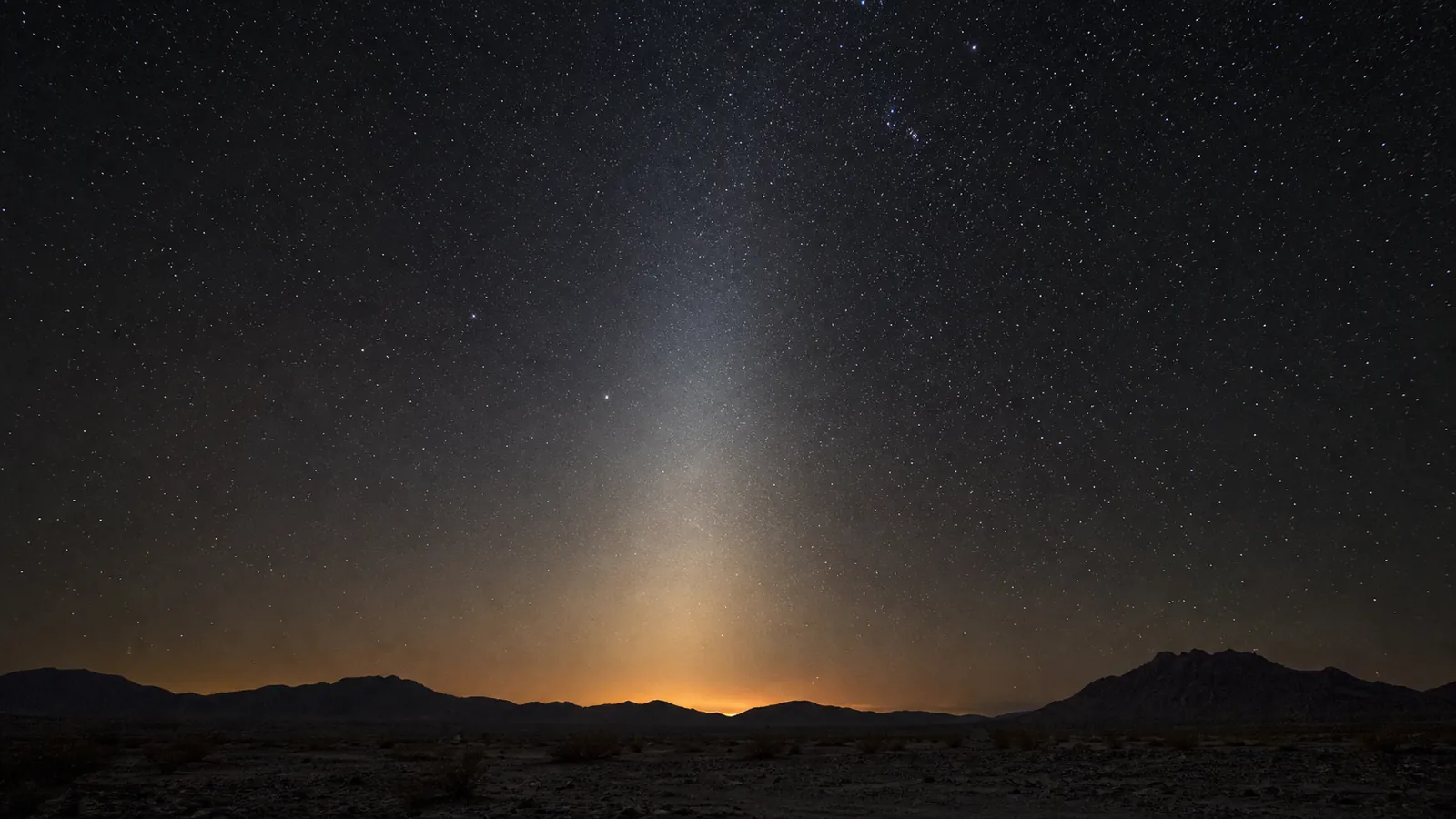
An hour after sunset in the Atacama, in the last week of any expedition between August and October, I walk the group away from camp, face them west, and ask what they see. Someone always says it first: a faint, enormous pyramid of light, leaning slightly to the left, rising from where the sun went down and reaching a third of the way up the sky. Most people assume it's the last of the sunset. It isn't. Sunset ended an hour ago.
What they are looking at is sunlight reflecting off a disk of interplanetary dust — trillions of particles, most smaller than a grain of flour, orbiting the sun roughly in the plane of the planets. Comets shed some of it; asteroid collisions grind out more; some of it, recent research suggests, may be dust storms from Mars. When you see the zodiacal light, you are seeing the construction debris of the solar system, backlit. Some of those grains are older than the Earth.
It is the largest single structure you can see from Earth's surface, and almost nobody alive has noticed it.
Why you've never seen it
The zodiacal light is genuinely bright — integrated across the sky it outshines the Milky Way. But it is diffuse, spread across tens of degrees, which makes it catastrophically vulnerable to skyglow. Under a Bortle 5 suburban sky it is simply gone. Even at Bortle 3 it reads as a vague brightening you'd never pick out unprompted. It needs Bortle 1 or 2, and it rewards them extravagantly.
The recipe
First, the geometry. The dust lies along the ecliptic — the line the sun and planets travel — so you want the ecliptic standing steeply out of the horizon after dusk or before dawn. In the northern mid-latitudes that means evenings in late winter and early spring (February–March, looking west after twilight ends) or mornings in autumn (September–October, looking east before dawn — old sky-watchers called this the false dawn, and it appears under that name in the Rubáiyát of Omar Khayyám). In the tropics and at our southern sites, the ecliptic stands steep nearly year-round, which is one reason the Atacama and NamibRand are the two best places on Earth to see it.
Second, the moon must be gone. Not low. Gone. Even a fat crescent will wash it out. Plan inside the window from three days after full moon (evening viewing) through two days after new. Every Aphelion departure already lives inside these windows, which is not a coincidence.
Third, the timing. Astronomical twilight has to be fully over — about 90 minutes after sunset, when the sun is 18 degrees down. There's a window of roughly an hour after that before the cone sinks. For the false dawn, reverse it: start two and a half hours before sunrise.
Fourth — and this is the one everyone skips — your eyes. Full dark adaptation takes 30 to 40 minutes, and one glance at a phone resets the clock. On our expeditions the phones go into pouches at dusk. Use averted vision: look 15 degrees to the side of where you expect the cone, and let your peripheral retina — which is far more sensitive to faint light — do the work. The pyramid will bloom into view at the edge of your gaze like something surfacing.
What to look for once you've caught it
The cone is just the beginning. From a true Bortle-1 site on a moonless night, the zodiacal light extends into a complete zodiacal band circling the entire ecliptic. And at the point directly opposite the sun, patient observers can find the gegenschein — a soft oval glow where each dust grain, seen at full phase like a trillion microscopic full moons, brightens just enough to notice. It is among the rarest naked-eye sights in nature. On the NamibRand expedition we dedicate an entire night to it, and most years, most of the group gets it. The moment someone finds the gegenschein for the first time — sunlight bouncing back at them off dust on the far side of the solar system — is the closest thing our itineraries have to a sacrament.
None of this requires a telescope. It requires darkness, geometry, and patience — the three things modern life is worst at providing and an expedition is engineered to provide absolutely. The dust has been up there for four and a half billion years. It can wait another forty minutes for your eyes.
Tomás Rivera has led Aphelion's Atacama Deep Field expedition since our first season. He has seen the gegenschein on 61 separate nights and keeps count, because, in his words, "somebody should be keeping score."