Field Guide · March 14, 2026 · 7 min read
Packing for minus twenty
Standing still under an Arctic sky is a different discipline than moving through one. Our Lofoten guides' complete layering doctrine.
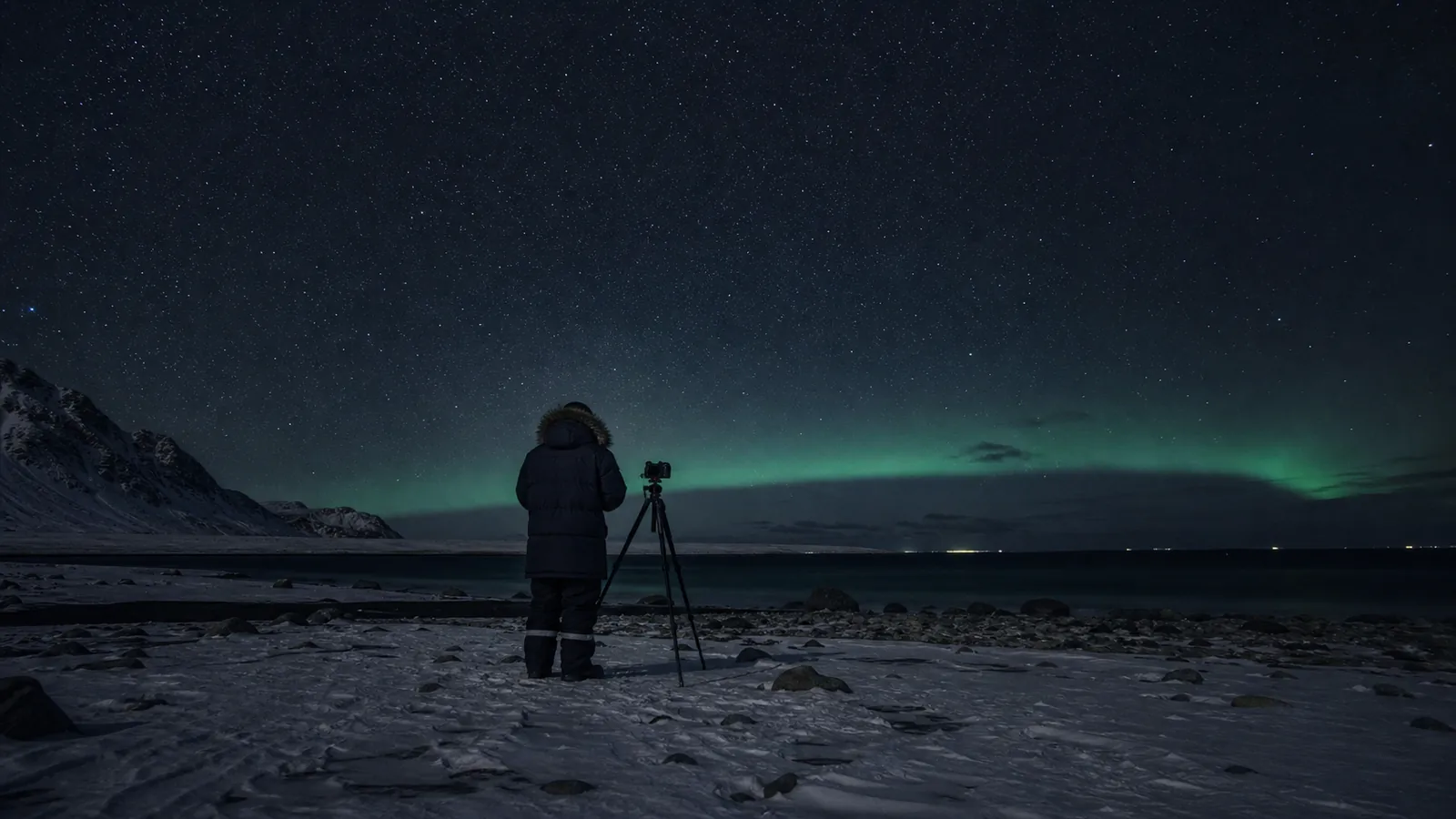
Every winter, somewhere in the second week of a Lofoten season, a traveler tells me they've skied at minus twenty and they'll be fine. They are usually not fine, and the reason is simple: skiing is exercise. Aurora watching is the art of standing completely still, outdoors, above the Arctic Circle, in the middle of the night, for four hours. Your body generates almost no heat doing it. Everything you'd normally count on your metabolism to do, your clothing has to do instead.
After nine seasons of watching people be cold in the most preventable ways, this is the complete doctrine. It is not a gear list with brand names — it is a set of principles with the physics attached, because travelers who understand why stay warm, and travelers who memorize brand names buy the wrong version of the right thing.
Principle one: sweat is the enemy, not cold
The walk from the van to the beach at Skagsanden takes eleven minutes. If you do it fully dressed, you arrive damp — and damp base layers at minus twenty will defeat any jacket ever made, because water conducts heat away from skin roughly 25 times faster than air. So we walk cold: shell open, hat off, big parka in your pack. You dress for standing still only after you've stopped moving. It feels wrong every time. Do it anyway.
Principle two: layers are a system, not a pile
Four layers, each with one job. Against your skin, merino or synthetic — never cotton, which holds moisture like a grudge. Over that, a fleece or light wool mid-layer for standing insulation. Then the big one: a parka with real fill — down if you're disciplined about moisture, synthetic if you're not — sized to fit over everything else, not fitted. Loft is the whole mechanism: you are wearing a blanket of trapped, body-warmed air, and a tight jacket has no room for air. Finally a windproof shell layer, because moving air strips the boundary layer of warmth off any insulation. A 20-knot Lofoten sea wind at minus ten feels like minus twenty-five, and the beach always has wind.
You are not dressing for the temperature. You are dressing for the stillness.
Principle three: your feet are standing on the cold
The ground is the one thing you touch all night, and conduction never sleeps. Boots rated for deep cold, a full size up, with room to wiggle your toes — compressed socks mean compressed insulation, which is why doubling up thin socks usually makes feet colder. One pair of heavy wool socks in a roomy boot beats two pairs in a snug one. And the single highest-value item nobody brings: a closed-cell foam pad to stand on. Two centimeters of foam between boot sole and frozen sand is the difference between lasting one hour and lasting four. We bring them for the whole group. Travelers laugh at them at 9 p.m. and fight over them at midnight.
Principle four: hands operate cameras; mittens don't
The working compromise, refined over hundreds of aurora nights: a thin liner glove that can work a camera dial, inside a big expedition mitten that flips or pulls off. Chemical hand warmers live in the mitten, not against bare skin. You expose the liner glove for the eight seconds a camera adjustment takes, then back in. Anyone who tries to run a camera bare-handed donates skin to the tripod eventually — cold aluminum takes its tax.
Principle five: heat is also caloric
Your body burns fuel to keep you warm, and at 1 a.m. the tank is low. We carry two liters of hot blackcurrant toddy per traveler and enough chocolate, nuts, and dried fruit to embarrass a ski lodge. Eat before you're cold. Alcohol stays at the rorbu — it vasodilates, which feels warm for ten minutes by shipping your core heat out to your skin and spending it. Save the aquavit for after, beside the wood stove, when the sky has finished with you.
The part nobody warns you about
Dress by these principles and something unexpected happens: you stop thinking about your body entirely. That's the actual goal. The aurora does not perform on schedule — it arrives in pulses, sometimes twenty minutes of faint green haze and then, without warning, the whole sky tearing open into curtains and spirals directly overhead. The travelers who miss it are never the unlucky ones. They're the cold ones, back in the van, warming up. Every layer in this doctrine exists to buy you the one thing that matters up there: the ability to still be standing on the beach, comfortable and patient, at the exact moment the solar wind decides to spend itself on the sky.
Ingrid Solheim leads the Lofoten Aurora Line and grew up in Svolvær, where her grandmother taught her that there is no bad weather, only bad clothing — a proverb she has professionally weaponized. Voyager and Custodian members can borrow the full thermal kit, foam pad included, through the loaner gear program.