Dark Skies · June 18, 2026 · 9 min read
What we lost when we lit the sky
Eighty percent of humans have never seen the Milky Way. This is a recent development — and a reversible one.
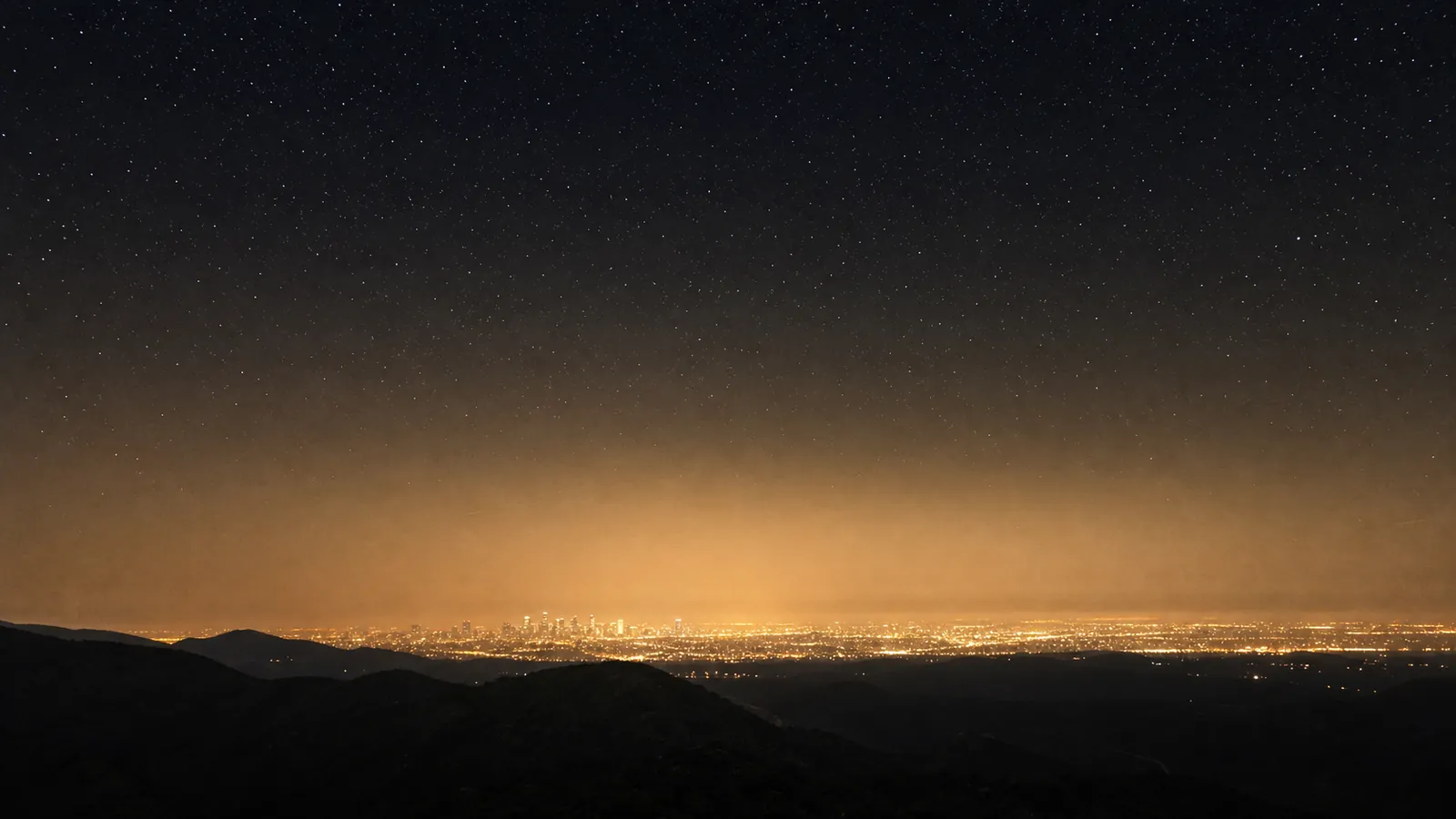
There is a photograph taken during the 1994 Northridge earthquake that astronomers still talk about. The quake knocked out power across Los Angeles at 4:31 in the morning, and in the hours that followed, emergency lines received a peculiar category of call: residents reporting a strange, giant, silvery cloud stretched across the dark sky. Some wondered if it was connected to the earthquake. It was the Milky Way. Millions of people were seeing their own galaxy for the first time, and no one had told them what it was.
The story is sometimes embellished in the retelling — but the substance is documented, and it points at something real. In roughly a single human lifetime, we managed to erase from view the most universal inheritance our species has. Every culture that ever existed built stories, calendars, navigation systems, and religions on the night sky. The Polynesians crossed the largest ocean on Earth with it. The Sān people of the Kalahari, whose descendants co-lead our NamibRand nights, have been reading it continuously for longer than agriculture has existed. And then, between roughly 1950 and today, we switched it off.
The numbers, plainly
The most-cited study of the atlas of artificial night sky brightness puts it starkly: more than 80 percent of the world's population — and 99 percent of Americans and Europeans — live under light-polluted skies. About a third of humanity can no longer see the Milky Way at all from where they live. Skyglow has been growing at nearly 10 percent per year in some regions since the widespread adoption of cheap LED lighting — a rate that halves the number of visible stars roughly every decade.
It's worth being precise about what this is and isn't. Light pollution is not light. It is wasted light — photons aimed sideways and upward at nothing, scattered by the atmosphere back down into your eyes. A well-shielded streetlamp and a badly designed one deliver the same light to the pavement. Only one of them also erases Orion.
Darkness is not the absence of something. It is the presence of everything else.
What it costs
The ecological ledger is longer than most people expect. Artificial light at night disorients the hundreds of bird species that migrate after dark — collisions with lit structures kill hundreds of millions of birds annually in North America alone. It suppresses melatonin in nearly everything that produces melatonin, which is nearly everything with a spine and much without one. Newly hatched sea turtles, wired to crawl toward the bright ocean horizon, crawl toward highways instead. Fireflies can't find each other. Pollinating moths — which do a surprising share of the night shift that bees get credit for — circle lamps until they die of exhaustion.
The human ledger is subtler but real: disrupted circadian rhythms, and a documented, measurable decline in what researchers call sky literacy — the basic ability to point at the sky and name what's happening there. We are the first generation of humans for whom the sky is optional. Most of us opted out without ever being asked.
The good news is genuinely good
Here is what makes light pollution unique among environmental problems: it is instantly, completely reversible. There is no residue, no half-life, no recovery period. The photons are gone the millisecond the switch flips — Northridge proved that at the scale of a whole city. No other pollutant offers that deal.
And the fixes are boring, cheap, and already invented. Full-cutoff fixtures that aim light only down. Warm-spectrum LEDs instead of the blue-heavy ones that scatter most aggressively. Motion sensors and curfews for lighting nobody is using — which studies of municipal systems suggest is a large fraction of it. Cities that have adopted dark-sky ordinances, from Flagstaff to Fulda, report no increase in crime or accidents. They do report something harder to put in a spreadsheet: residents who can see stars from their porches.
This is why one percent of every Aphelion Custodian membership funds dark-sky preservation grants — retrofit projects, ordinance campaigns, and reserve certifications. Since 2022 that fund has granted $214,000. It is, honestly, the most cost-effective conservation money we know of.
Why we take people to see it
You can read every statistic in this essay and nod along, and none of it will do to you what four minutes under a Bortle-1 sky does. We have watched it happen to hundreds of travelers now, and the pattern is consistent: about four minutes in, as dark adaptation starts to arrive and the sky keeps deepening — more stars, then structure, then the great banded arch of the galaxy with its dust lanes and its glowing core — people stop talking. Not politely. Involuntarily.
That silence is the whole company. We don't think of our expeditions as tourism. We think of them as repatriation — returning people to something that was always theirs. The sky hasn't gone anywhere. It's waiting above the streetlight, complete and indifferent and magnificent, for whoever is willing to go stand where it's still visible.
Turn off a light tonight. Better yet — come stand somewhere truly dark, and see what your grandparents traded away without meaning to. Then help us get it back.
Dr. Mireille Okafor is Aphelion's co-founder and Chief Sky Officer. She spent nine years on the instrumentation team at the Paranal Observatory before deciding the general public deserved the view more than her spectrographs did.